From Influence to Impact: Tax Leaders Navigate a New Era of Change

Executive Summary of Findings from the 2026 BDO Tax Strategist Survey

Tax Leadership at an Inflection Point

Tax has reached a strategic inflection point. The function has earned meaningful influence at the enterprise level, but influence alone is no longer sufficient. The 2026 BDO Tax Strategist Survey shows that the challenge for tax leaders is not gaining a seat at the table, but sustaining and expanding their impact across the full breadth of the business. Doing so requires confronting intensifying pressures, including policy volatility, rising total tax liability, and underdeveloped technology infrastructure.

What This Report Reveals

  • How the tax function can leverage its influence to embed a total tax approach across the enterprise
  • How operating models are evolving in response to regulatory complexity
  • Where technology infrastructure investment is most needed to strengthen compliance and unlock more advanced planning capabilities

Download the full survey report or continue reading for a summary of key findings.

Summary of Findings

Tax leaders have secured a seat at the decision-making table, but deepening the influence will take work

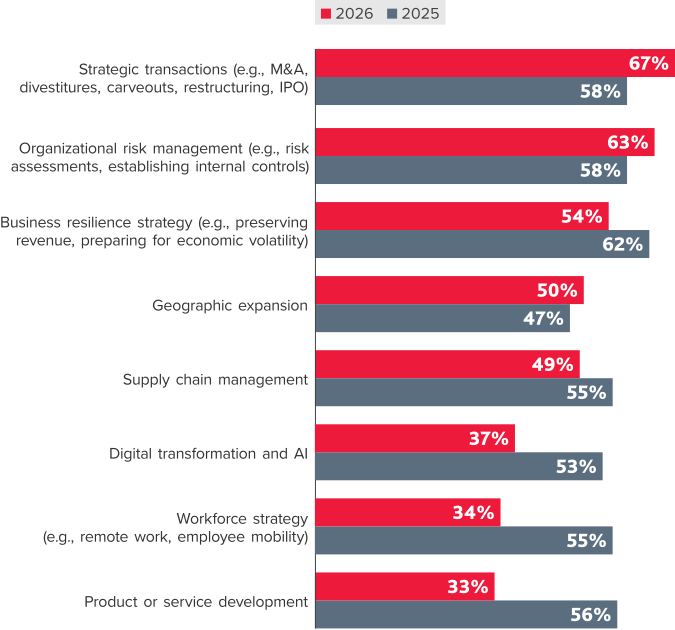
Over the past several years, the BDO Tax Strategist Survey has tracked the rise of the tax function’s strategic influence. This year, 94% of tax leaders report being consulted before business decisions are made, with their recommendations carrying significant weight, a four-point increase from 2025. Tax's involvement in strategic transactions rose nine points this year, and its participation in organizational risk management increased five points, underscoring a function now embedded in the organization’s most consequential conversations.

However, the data also reveals a more nuanced reality. Tax's influence is concentrated in a handful of high-stake areas where attention is most required, while its involvement in broader issues such as business resilience — including revenue preservation and preparation for economic volatility — has declined.

The collaboration gap is equally significant. Only 38% of organizations have a defined process for cross-functional teams to engage the tax function on matters with potential tax implications. Without formal engagement structures, tax is often absent from discussions where its perspective could materially alter outcomes, creating planning blind spots and unmanaged risk exposure across the organization.

Deepening tax's role in strategic decision-making requires investment in both relationships and infrastructure and often begins with the CFO. As the CFO’s scope of responsibility expands, their sponsorship of the tax function becomes a decisive factor in elevating tax’s influence. The CFO’s ability to bring tax into strategic conversations early, align stakeholders, and formalize engagement processes sets the foundation for consistent enterprise-wide collaboration. Structurally, tax must build the data, tools, and reporting capabilities that allow it to demonstrate value with clarity and consistency. Together, these investments enable a total tax approach that strengthens growth and resilience through proactive planning and risk management.

Strategic Discussions in Which Tax is Very Involveddiscussions in which tax is very involved

Tax leaders have worked hard to earn a seat at the strategic table — and the data confirms that work is paying off. But a seat at the table only matters if you're in the room for the right conversations. Tax leaders must be sure tax is embedded in the decisions that shape the business, not only the ones that affect the balance sheet.

 - Mathew DeMong, National Managing Principal of Tax

Policy Volatility Is the New Normal, and Most Organizations Aren't Built for It

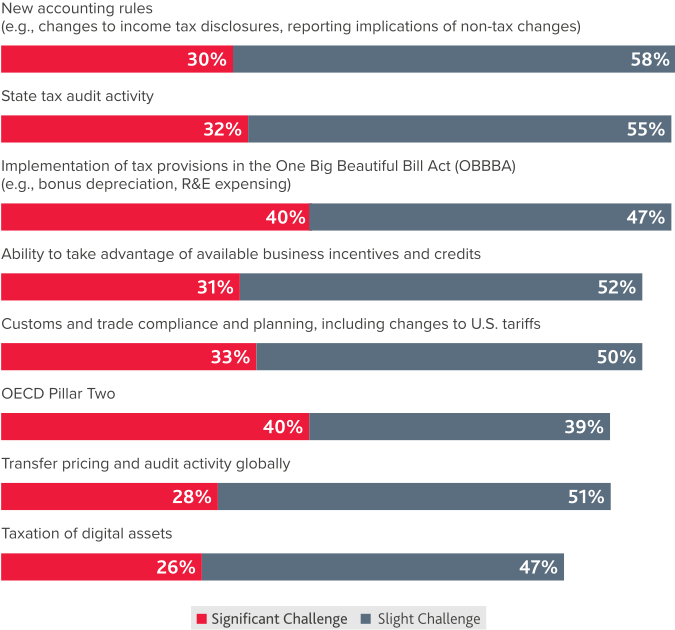
Multiple concurrent policy disruptions — including tariff volatility, state, federal, and global tax reform, and new accounting rules — are dramatically increasing complexity. Thirty percent of tax leaders cite regulatory complexity as their top tax risk for the next 12 months, more than double the 13% who said the same in 2025.

Nearly a year after enactment, the One Big Beautiful Bill Act (OBBBA) remains a major challenge: 87% of tax leaders report difficulty implementing its provisions. State-level decoupling from federal OBBBA provisions adds further complexity, requiring tax teams to manage massive datasets across a patchwork of jurisdiction-specific reporting requirements.

Tariff volatility continues to disrupt operations. Despite ongoing International Emergency Economic Powers Act (IEEEPA) refund claims, businesses should expect continued tariff activity. Yet many businesses are not fully deploying tariff management strategies: only 49% conduct transfer pricing reviews, 42% conduct tariff code reviews, and just 25% pursue duty drawback strategies.

The Top Policy Challenges in the Year Ahead

New accounting rules chart

The pace and scale of policy changes we're seeing right now is almost unprecedented. Tax leaders can't afford to sit on the sidelines — they need practical tools to model planning scenarios and concrete tax strategies that offer immediate and consistent value. Organizations that employ cross functional teams to proactively address challenges and seize planning opportunities will have a significant competitive advantage.

 - Dustin Stamper, Washington National Tax Managing Director, Legislative Affairs

Technology Ambition is Outpacing Readiness, and the Gap is Growing

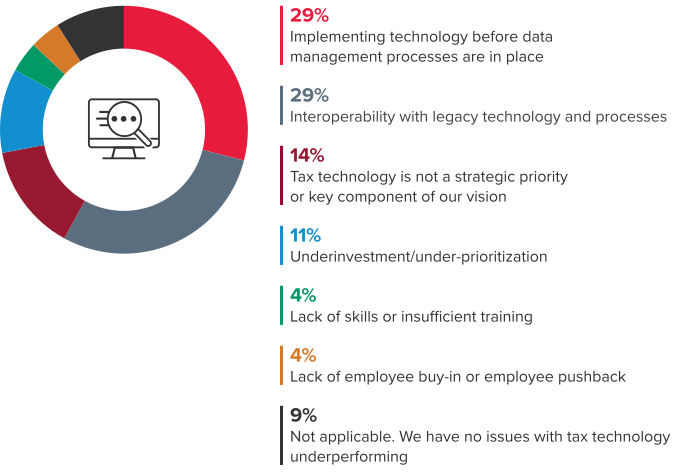
While leaders plan to increase investment in tax technology, most middle-market companies lack the data and systems maturity to adopt the AI and automation tools needed for an agile tax function. The top barriers to successful technology initiatives are implementing tools before data management is in place (29%) and poor interoperability between tax and legacy systems (29%). Closing these foundational gaps is essential to unlocking the full value of emerging technology.

AI adoption is growing, but primarily at the execution layer. The most common use cases — task-specific deployment (28%) and multi-process embedding (21%) — focus on accelerating existing work. Only 18% of tax functions use AI for complex analysis and cross-functional collaboration. Scenario modeling and forecasting — the capabilities most critical for risk management and strategic planning — remain the least mature, with only 38% of tax functions reporting high technology integration.

Without clean data and integrated systems, new tools introduce new problems: version-control errors, accuracy issues, and audit exposure. The path forward begins with establishing a single source of truth for tax data and the governance protocols to support it. From there, tax leaders can build a roadmap that prioritizes AI use cases for forecasting, scenario modeling, and cross-functional planning.


The Top Reason Technology Inititves Underperform

Reasoning why technology initiatives underperform

As organizations continue to invest in tax technology, many are recognizing the importance of strengthening the data and systems environment that supports it. AI and automation deliver the greatest value when built on a foundation of reliable data, integrated systems, and clear governance. Organizations making the most progress are often advancing technology investments alongside practical improvements in data quality and integration.

 - Brad Ford, National Tax Leader, Tax Automation & Innovation

From Influence to Impact: What Tax Leaders Do Next

Tax has secured its strategic role, but sustaining it requires infrastructure, process, and investment across three priorities.

Formalize engagement processes and request leadership sponsorship to bring tax into cross-functional conversations earlier and more consistently. Establish controls and protocols that make tax a default stakeholder — not a reactive one. Strengthen the tax-finance partnership to jointly advance technology priorities, manage risk, and drive business outcomes.

Organizations that navigate this environment most effectively have operating models designed for rapid adaptation. This includes cross-functional coordination structures, scenario-modeling capabilities, and engaging advisors to establish the right mix of in-house talent, outsourced resources, and technology solutions to remain nimble.

Technology investment must follow data infrastructure work. Partner with finance and IT to establish a single source of truth for tax data and the governance protocols to support it. From that foundation, build a roadmap that prioritizes AI use cases for forecasting, scenario modeling, and cross-functional planning.

Download the 2026 BDO Tax Strategist Survey to see the complete findings, data, and recommendations or register for our webcast to hear key insights from the report.