
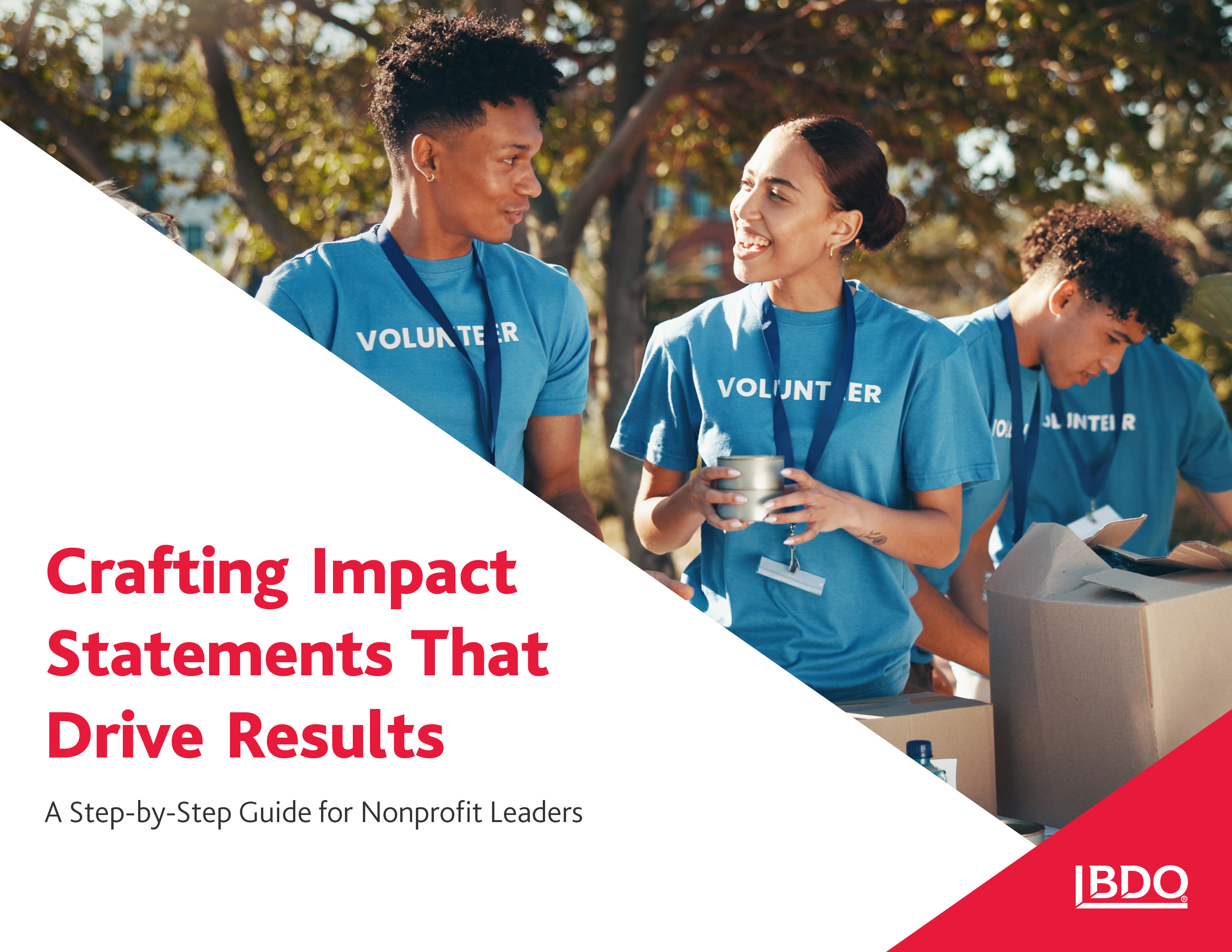
Crafting Impact Statements That Drive Results
A Step-by-Step Guide for Nonprofit Leaders
Key Takeaways
- A nonprofit impact statement explains the problem you address, your organization’s approach, and measurable outcomes.
- Strong impact reporting builds donor trust and strengthens grant proposals with clear, outcome-focused evidence.
- Focus on outcome measurement, not just program activities, to show real change for people and communities.
- Apply a Human, Compelling, Visual Communications™ framework — clear, people-centered, and visual — helps nonprofits turn complex data into messages that motivate action and support fundraising goals.
Introduction
Every nonprofit has a story, but as competition for funding increases, clearly communicating impact matters more than ever. Donors, funders, and other stakeholders want to see strong evidence that their support is making a difference. In fact, 93% of donors in a 2025 philanthropy survey said they are more likely to give knowing the impact of their contributions.
For nonprofit leaders, crafting a powerful impact statement is one of the most effective ways to demonstrate results, build trust, and inspire action. This guide will walk you through the steps to create an impact statement that transforms data into a compelling narrative, motivates and energizes stakeholders, and sets your organization apart.
As funding competition grows, nonprofits must clearly prove impact—building trust, inspiring action, and showing donors their support truly makes a difference.
What Is an Impact Statement and Why Does It Matter for Nonprofits?
An impact statement is a concise, data-backed declaration that explains the challenge your nonprofit addresses, your unique solution, and the measurable results you achieve. It answers the essential question: “What does our data reveal about the problem we’re solving, and how does it prove our effectiveness?”
While closely related, an impact statement differs from traditional mission, vision, or values statements.
- Mission Statements focus on what your organization aims to do
- Example: “To provide food and shelter to individuals experiencing homelessness”
- Vision Statements describe the ideal future state your organization hopes to achieve
- Example: “A community where no one experiences housing or food insecurity”
- Values Statements name the principles that guide behavior within your organization
- Example: “Compassion, Integrity, Collaboration”
Unlike these organizational statements, an impact statement is rooted in concrete evidence and focused on outcomes. It’s your nonprofit’s proof of impact, delivered in a way that’s clear, memorable, and actionable.
Example: Our data reveals that 90% of children in our after-school program improve their reading levels by two grades within a year, breaking cycles of academic struggle and empowering futures.
Why Impact Statements Matter for Nonprofit Success
Building donor confidence is essential for nonprofit growth. According to the Fundraising Report Card, 59% of respondents say shared accomplishments are the top signal of a charity’s trustworthiness, underscoring the importance of clear, data-driven impact statements. A strong impact statement can:
Donors want proof their gifts matter. A clear impact statement delivers that evidence.
Regularly analyzing your data sharpens your understanding of what works — and what doesn’t.
Volunteers, community partners, and staff feel more connected when they see the real impact of their efforts. It fosters a shared sense of purpose and reinforces the value of their involvement.
Grantmakers prioritize data-driven proposals. Your impact statement showcases your commitment to measurable outcomes.
Data-backed stories make your voice louder and more influential in policy and public debates, raising awareness and driving systemic change.
A Common Pitfall
to Avoid
Transparency is key to sustaining donor support. The Fundraising Report Card also reports that 1 in 4 potential donors would be discouraged from giving if they weren’t sure how the charity would use their money and 1 in 5 would feel the same if the charity did not share clear recent accomplishments. An effective impact statement directly addresses this concern by showing exactly how contributions make a difference.
5 Steps to Create a Successful Impact Statement
Define the Challenge and Your Unique Solution
Clearly state the core challenge your organization addresses and what makes your approach effective. Gather insights from frontline staff and dig deeper to identify the specific needs you meet.
Identify and Visualize Key Data
Choose metrics that best illustrate your impact. Focus on outcomes (e.g., reduced food insecurity) rather than just outputs (e.g., meals served). Use Human, Compelling, Visual Communications™ — leveraging charts, infographics, photos and video — to make your results easy to grasp.
Ask “What, So What, Now What?”
For each data point, ask: “What does this tell us? So, what’s the bigger story here? Now, what do we do with what we know?” Facilitate discussions with your leadership team and board to explore the deeper meaning behind your data. This process helps you connect numbers to real-world change and actionable insights.
Craft a Clear, Concise Narrative
Combine your challenge, solution, and results into one or two powerful sentences. Use active voice and strong verbs. Pair your statement with visuals or testimonials for greater impact.
Make It Future-Focused and Actionable
Highlight ongoing needs and future potential. Use your impact statement to inspire action, whether it’s donating, volunteering, or advocating. Focus on creating an impact statement that can evolve as your programs and data grow.
Putting Your Impact Statement to Work
Once you’ve crafted a results-driven impact statement, integrate it into your communications strategy:
- Internal Team Alignment: Help every team member understand and articulate your impact statement confidently.
- Donor Communications: Feature it in grant proposals, annual reports, and fundraising appeals.
- Marketing and External Communications: Display it prominently on your website, social media, and outreach materials.
Frequently Asked Questions
A concise, data-driven summary that explains how a nonprofit’s programs create measurable social or community outcomes.
A mission statement defines purpose, while an impact statement demonstrates results using evidence and outcomes.
They provide transparency and proof of effectiveness, helping stakeholders understand how their support creates change.
Clear outcome data, plain language, and human-centered, visually engaging communication that makes results easy to understand.
Regularly, as new outcome data becomes available and programs or priorities evolve.
How BDO Can Help
We help mission-driven organizations turn data into compelling impact statements and visuals that drive results. We support you in crafting narratives that inspire donors, engage stakeholders, and advance your mission.
Ready to write an impact statement that sets your nonprofit apart?
SHARE