
Why the Next Generation of Strategy Work Will Not Be “Plans” at All
Strategic planning often begins with a deceptively simple decision: an organization determines that it needs a strategic plan. But before leaders define the scope, select an advisor, or begin the planning process, there is a more fundamental question to answer: What kind of strategic planning effort does the organization actually need?
Yet, ask most organizations what they are preparing to commission and the answer is the same: a strategic plan. But the phrase does not describe a single product. Strategy work is a family of distinct instruments that share a label, but differ in what they are designed to accomplish, how far out they look, and which disciplines they need to operate effectively. Buying the wrong one or buying the right one without the disciplines that make it work is the mismatch underneath most shelved strategy.
The previous articles in our Nonprofit Organizational Strategy Thought Leadership series named the disciplines that make a plan stick and the moves that put them into a request. Now we explore the part that comes first: a way to clearly identify which kind of plan you are commissioning, so the disciplines you scope align with the plan’s requirements. Get this first step right and much of the rest of the series becomes a checklist. Get it wrong and no amount of discipline downstream fully recovers it.
The Five Types of Strategic Plans
From our experience, strategic engagements generally fall into five recognizable types. The categories are not rigid, and an engagement may combine elements of more than one. Still, identifying the closest type helps leadership select the instrument best suited to the organization’s needs. Naming the types shifts the question from how much plan to buy to which instrument the work requires. The five types of plans, from the lightest to the most ambitious, include:
- Leadership-alignment plan. This approach is appropriate when the organization’s overall direction is largely settled, but leaders need greater alignment, shared ownership, or clarity about how they will work together. It typically requires a lighter stakeholder process and greater emphasis on governance, leadership behavior, and reinforcement.
- Plan refresh. A refresh updates an existing plan when the organization’s overall direction remains sound but priorities, assumptions, or implementation needs have changed. Because the fundamental direction is already established, the engagement may require less discovery and deliberation and greater emphasis on performance management, accountability, and reinforcement.
- Departmental or functional plan. This type focuses on a specific function, department, or program. It may translate the enterprise strategy into functional priorities or establish direction for an area that needs its own planning framework. It generally requires clear alignment with broader organizational goals, along with appropriate performance management, ownership, and reinforcement.
- Whole-entity direction-setting plan. This approach establishes or resets strategic direction across the organization. It is the most discipline-hungry of the plan types because the work does not stop at defining direction; it must also create the conditions for that direction to take hold across the organization. That typically requires several disciplines working together, including change management, governance, risk, performance management, communications and training, and reinforcement.
- Management system. This is the most comprehensive approach. It combines strategy development with the structures needed to manage strategy continuously, which may include governance, performance cadences, decision rights, risk management, organizational design, and implementation capacity. Rather than ending with an adopted document, the engagement helps establish how the organization will operate and adjust the strategy over time.
The names matter less than the recognition that these are different engagements with different requirements for each. Naming the type helps leaders match the work they commission to the support it needs to succeed.
Leaders can begin narrowing the choice by asking:
- Is the organization setting a new direction or strengthening alignment around an existing one?
- Does the work apply to the entire organization or to one function, department, or program?
- How much stakeholder involvement and organizational change will the effort require?
- Does the organization need a plan, early implementation support, or an ongoing system for managing strategy?
- Which capabilities already exist internally, and which must be established through the engagement?
These questions do not replace a well-defined scope, but they help ensure that the scope begins with the organization’s actual need rather than a generic request for a strategic plan.
Two Choices Cut Across the Types of Plans, and Both Are Easy to Get Wrong
Once the organization identifies the type of planning effort it needs, two additional decisions shape every plan: the planning horizon and implementation support.
Planning Horizon: Leaders should determine how far into the future the plan needs to look. Most plans land at three to five years, with the most ambitious reaching further, but the short end is where confusion creeps in. What organizations sometimes call a one-year strategic plan is usually an annual operating plan, a different instrument with a different job, and treating one as the other produces a document that satisfies neither need.
Implementation Support: Organizations should also decide whether the engagement includes putting the plan into operation or stops at the document. A plan that ends at document delivery and a plan that carries through early implementation are different commitments with different costs, and the choice should be deliberate rather than discovered halfway through.
The type of plan tells you which disciplines belong in the work. The horizon and implementation scope identify how much of each.
The Failure is Rarely the Type You Choose; It Is the Disciplines You Forget to Match to It
The recurring failure is not that organizations pick the wrong type of plan, though that happens. They pick a type and then scope it as if it were the simplest option, naming the document and omitting the disciplines that particular plan type needs to operate. A whole-entity direction-setting plan commissioned with no governance or reinforcement is the most common version of this mismatch. It is the same pattern this series opened with, outputs without disciplines, now visible at the level of the engagement type itself. The discipline that prevents it is simple to state but easy to overlook. Name the type, then scope the disciplines that type requires, no fewer and no more. A light plan type carrying the full apparatus is overbuilt; an ambitious plan type carrying none of it is destined for the shelf. Much of what later looks like a strategy failure is really a typing failure that happened months earlier, at the moment the work was scoped.
Plan and Management System Are Two Ends of One Spectrum, Not A Choice Between Two Things
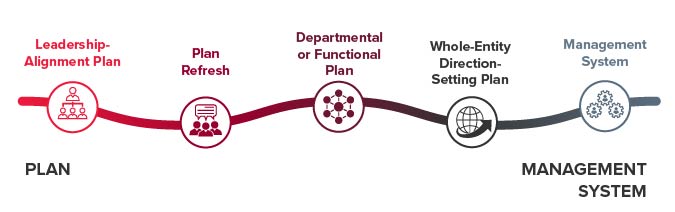
This is what the question in the title of this article resolves into. A strategic plan, in the narrowest sense, is a document: vision, goals, a roadmap — the artifact a board adopts. A strategic management system is an operating system: the governance, measures, risk discipline, performance cadences, and reinforcement that keep strategy alive after the planning team has gone. The market tends to treat these as a choice between two products. They are better understood as the two ends of the options above, with most real work sitting somewhere between them. The shift worth making is not that every organization should buy the management system. It is that organizations should stop buying a thing called a strategic plan as if it were one product and start choosing a position on the spectrum on purpose, matched to the mandate in front of them. The most consequential and durable work does sit toward the management system end of the spectrum because that is where strategy stops being a document and becomes the way an organization runs. The goal is not to maximize the scope of the engagement, but to match it appropriately to the organization’s needs.
Commission a Place on the Spectrum, Not a Document Called a Plan
For an executive, this changes the first question of any strategy effort from “what should the plan say?” to “which instrument are we buying, and what does it need to operate?”. For a board, it changes what to ask before approving the work: not only what the plan proposes, but whether the engagement was scoped as the appropriate type the mandate requires. For a funder, it reframes the measure of success away from the mere existence of a plan and toward the disciplines that will keep it working.
The next and final installment in our nonprofit organizational strategy series turns all of this into a practical test any leadership team can run on the plan it already has developed. Throughout the series, our aim has been to help organizations commission strategy work designed not only to be adopted, but to be put into practice, starting with a clear understanding of the kind of strategy work they need.
How BDO Can Help
BDO helps nonprofit executives and boards determine the type of strategic planning effort their organization needs and connect that choice to the appropriate scope, operating disciplines, and implementation support. Our professionals work with organizations to clarify strategic direction, strengthen leadership alignment, establish governance and performance management structures, and build the capabilities needed to sustain strategy after adoption.
Whether your organization is refreshing an existing plan, setting a new enterprise-wide direction, aligning a department, or developing a broader strategic management system, BDO can help match the approach to your organization’s mandate, capacity, and readiness.
Contact us to discuss how your organization can commission a strategy process designed to guide decisions and support implementation over time.