
From Social Feed to Stock Feed
Sales, marketing, and inventory data will always form the bedrock of retail operations, but today’s leaders can leverage data from sources far beyond their own internal systems. External channels like social media, reviews, and market reports can provide visibility into market shifts that internal data does not capture.
Thanks to generative AI, interpreting and synthesizing this wide-ranging information is faster and easier than ever before, allowing retailers to understand trend clusters, conduct multimodal video analysis, and use sentiment analysis for a robust market picture.
In 2025, generative AI funding in retail surged to $33.9 billion globally, an 18.7% year-over-year increase, according to All About AI. This metric underlines the industry’s surging appetite for AI tools that can help retailers enhance their decision-making.

Using advanced tools to help predict demand is a radical shift from historical methods. Retail leaders have traditionally relied on month-over-month sales and prior demand metrics to forecast potential trends but now can use real-time marketplace signals to anticipate trends as they emerge rather than react retroactively.
For example, machine learning (ML) algorithms can analyze audio, captions, and visual cues in social media videos, to detect key words or descriptors that may signal changes in consumer demand. Generative AI can then combine those findings with sentiment analysis and other contextual data to deliver a comprehensive recommendation about how best to handle an imminent demand spike or slowdown. That said, most social data is still messy. Models can overreact to hype, so retailers need safeguards that prevent false positives from turning into excess inventory.
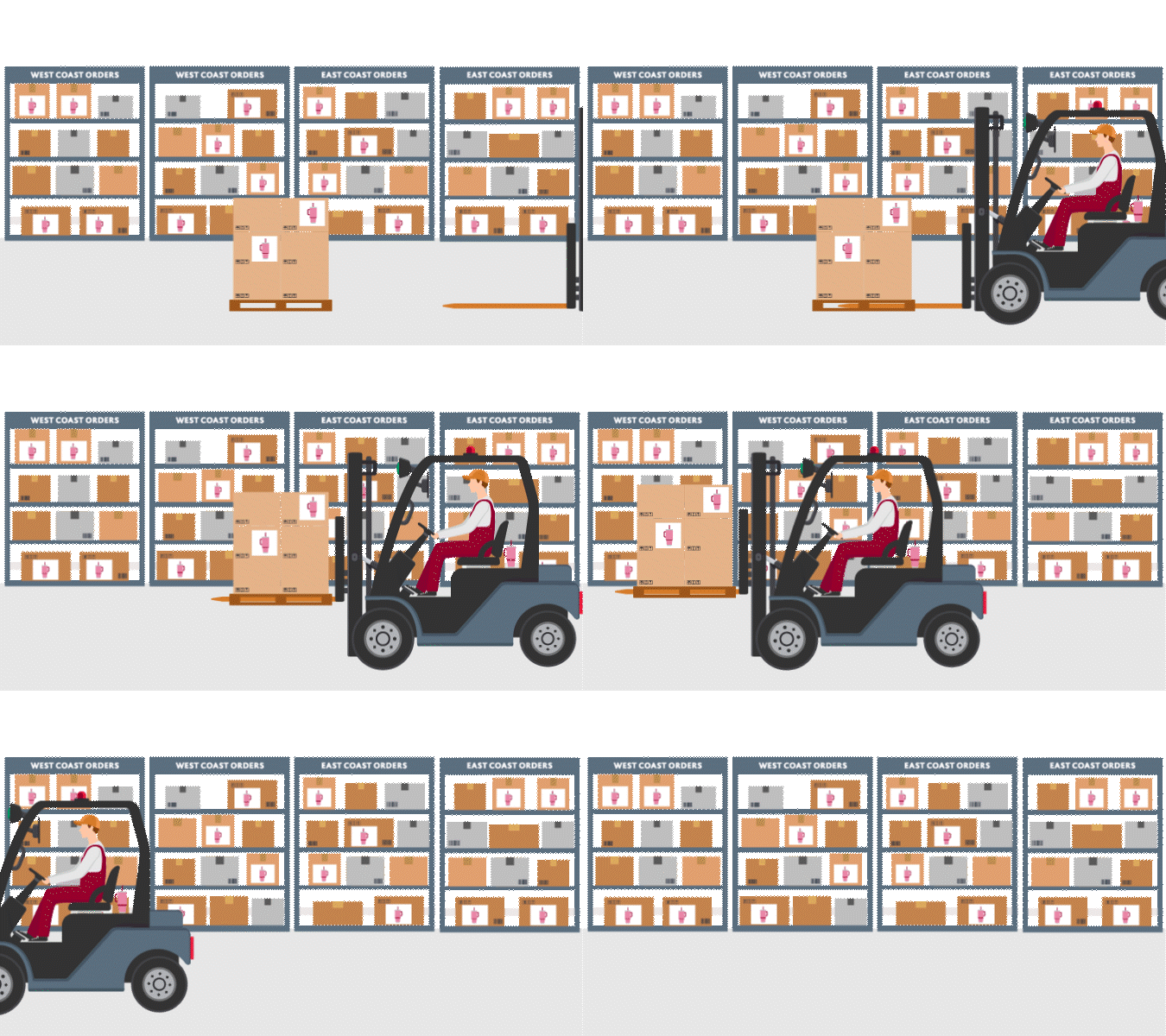
For organizations looking to truly future-proof their operations, agentic AI can go a step further — autonomously acting on select recommendations based on parameters set by the retailer. In practice, an agentic bot could shift inventory between regions, generate a purchase order draft, or update vendor quantities when SKU velocity crosses a certain threshold.
In the past, this level of analysis and execution required hours of manual work. Once a retailer identified a change in demand, they would still have to adjust dozens of different orders across multiple vendors, call suppliers, pull in new SKUs, and more. AI has changed that. Its ability to spot trends in advance can provide a major competitive advantage, but retailers still need the right people, processes, and mindset to turn those insights into action. To support this level of autonomy, retailers will also need clean, connected data and solid governance to keep AI-driven actions consistent, traceable, and compliant.
Ready to learn how to turn your AI companion into a true co-captain? Check out our on-demand webinar: How AI and Copilot Drive Transformation, for out-of-this-world insights.
Translating Social Signals Into Smarter Forecasting
To leverage generative AI effectively, retailers need to take deliberate steps to prepare their organization. Consider the five steps below to get started.
Step 1: Build a Solid Data Foundation
AI is only as good as the data it ingests, meaning inputs must first be clean and accurate. By integrating their data across systems, retailers can then connect sales, marketing, inventory, and external sources, allowing AI to use a variety of data inputs for a clear picture of demand trends. For most retailers, this requires cleaning up inconsistent product data, eliminating duplicate SKUs, and connecting systems that have long operated in silos. Unifying data into one master data depository allows AI to generate meaningful recommendations. A strong data foundation must also include robust data governance. Retailers should establish roles and responsibilities for consistency, reliability, and compliance.
 Step 2: Define Risk Appetite
Retailers must assess their willingness to act on signals generated by AI models, particularly those coming from fast-moving sources like social media. These social signals can be noisy or short-lived, and the cyclicality of customer trends creates an inherent risk for fast movers. By the time a retailer has adjusted its inventory orders to meet a budding demand, customer attention may have already turned elsewhere. By working to balance speed with experience and judgment, leaders can establish a baseline tolerable risk exposure and act more strategically when determining which opportunities are worth chasing.
Step 3: Train and Test AI Models
A commitment to training and experimentation is critical to support any AI use case. Models need guidance to help them distinguish between real demand shifts and temporary noise. For retailers using agentic AI, autonomous agents also require testing to ensure they follow escalation rules and avoid unintended actions. Explicit instructions and regular model testing can allow retailers to standardize processes, mitigate errors, and enable their AI models to make repeatable recommendations.
Step 4: Tag and Analyze Data
Future-focused retailers need to look beyond topline trends and identify the underlying factors influencing them. Promotions, seasonal shifts, and marketing campaigns can all skew demand data, creating spikes that aren’t purely organic. Assuming every spike is worth acting on can lead retailers to make decisions based on short-lived trends or inorganic shifts in consumer appetite. Careful analysis — paired with human judgement — is critical for AI-driven demand planning to work as intended. To better understand the data, retailers should invest in upskilling their teams to develop necessary technical literacy. Ideally, teams should be comfortable working with AI independently to interpret its recommendations and layer their own judgement on top to inform decision making.
Step 5: Iterate and Evolve
Implementing generative AI for demand forecasting is a journey. Organizations must always evolve and iterate on their models and agent rules to redefine guardrails and improve decision thresholds and triggers. Retailers should run controlled experiments to validate AI outputs and encourage cross-team collaboration to share insights, refine data governance, and adjust strategies over time. Using generative AI is a learning process, so the more retailers experiment, the more the model learns and can better adapt recommendations to time the market.
How BDO Can Help: Taking Trendspotting to the Next Level
Smarter demand signals, faster inventory moves, and AI-powered insights: this is the next era of retail operations. BDO is here to help retailers like you transform your business.
BDO Digital’s Data Analytics and Consulting team can help you future-proof inventory management and ordering processes through strategic adoption and implementation of AI tools. We can work with your organization to build a strong data foundation, enabling advanced analytics and providing your AI tools with the inputs they need to recommend actionable insights for demand planning.
BDO’s team of supply chain consulting professionals can also help you align data-backed decision making with supply chain impacts. Our supply chain professionals can support coordination of vendor networks, product ordering, and supply chain systems, and can help evaluate your technology infrastructure to identify where upgrades are needed. Our team works with yours to identify high-impact generative AI use cases that can unlock critical competitive advantages in a changing retail market.